Showing posts with label tactics. Show all posts

Friday, 16 February 2018

Diamonds are Forever: Why Liverpool Need to Revert to an Old Tactic

One of the hallmarks of Liverpool’s barnstorming 2013/14 season was the narrow 4-4-2 diamond adopted by Brendan Rodgers. Since Klopp has taken charge, this has given way to at least a notional 4-3-3; in recent weeks Mohamed Salah has become something of a de facto striker, but the line-up is nonetheless still two players who are traditionally wingers operating alongside a forward. Klopp’s tenure has by no means been unsuccessful – the fact that the team are in the Champions League knockout rounds for the first time since 2009 is testament to this – but goals have sometimes been a little harder to come by than they were in the peak season under Rodgers. This is of course partly attributable to the then-available talents of Luis Suarez and Daniel Sturridge, but the formation plays its part too. Liverpool’s current front line is at the very least comparable with the duo of Suarez and Sturridge, which is in itself a high compliment indeed, but they can nonetheless sometimes struggle against the low block. It could be worth experimenting with the narrow diamond once more against teams that like to try and frustrate Liverpool in this way. 


What are the advantages of such a formation? Essentially, it forces the team using it to play narrow – none of the attacking options are wide players, so forward play is channelled through the middle of the pitch. This means that the only way into the box is through intricate passing combinations. All too often, Liverpool have been lured out wide by the available space and then launched in aimless crosses: this does not play to the strengths of their forwards, who are not target men, and generally does not produce results. It would be preferable if they remained patient, moving the ball around in the centre until gaps are prised open. It is then a case of picking that gap and finding a runner, who is duly free of the low block. It requires a fairly high level of technical expertise, and an even higher level of discipline, but once it is drilled into the players it produces results far more reliably than slinging in crosses. It would be doing the current crop of central players a disservice to presume they are not capable of excelling in such a system. It may well get the best out of the technically-gifted Gini Wijnaldum. Henderson, too, is a good passer of the ball – one of the biggest complaints against him is that he likes to shift it sideways, so removing this option may actually help him. Can’s strengths lie in positive driving runs, which can also serve to open up a bit of space to pick the right pass: in short, the central options seem well-suited to the narrow diamond.


In terms of Liverpool’s current attacking personnel, however, the suggestion of this formation seems strange. The only regular first-team player who is generally classified as a striker is Roberto Firmino. The formation requires two forwards, and leaves no room for wide attackers – thus one of Mane or Salah has to play up front, with the other possibly missing out altogether. As mentioned, however, Salah is effectively playing as a striker anyway. There is no doubt that the Egyptian would continue to thrive in the proposed setup, as it would not substantially alter his role. The issue with leaving out Mane is less easily resolved. There are effectively two solutions: accept that he has to be sacrificed in order to reap the benefits of the narrow diamond against lesser teams, or else play him up front with Salah and drop Firmino into the number 10 role. Neither are necessarily ideal. Mane hasn’t had the best of seasons by his standards, but still brings enough to the team to warrant reluctance to drop him. Firmino, by contrast, has been a revelation up front, to the point where shifting him deeper seems counter-productive. However, part of his brilliance has been his ability to create for others – there is no reason to think that he could not continue to excel when playing behind two strikers, even though his output might take something of a hit. It may be worth at least trying it, so as to try and find the key to consistently unlocking low blocks.


This solution is particularly appealing when Liverpool’s full-backs are considered. Moreno and Robertson are the options at left-back, with Gomez and Alexander-Arnold the available options on the other side: of these, three would properly be classified as attacking full-backs. Only Gomez, who is a natural centre-back, is more conservative. Games where this formation would be most useful are against teams that set up with little attacking intent; there is therefore no issue in picking two of the offensive-minded full-backs. Width is duly provided, even though the formation does not involve any wide attackers. The whole point of the tactical setup is that the team are not constantly looking to the wing, but these full-backs at least provide an out-ball as a worst-case scenario in order to prevent turnovers of possession. Some form of in-game tactical flexibility is also maintained. If it comes to it, Liverpool’s full-backs all have a decent delivery on them, and are capable of picking out someone like Solanke if Klopp truly feels that the block cannot be broken down in any other way. Again, this must be considered a last resort, as the entire point of utilising the diamond is to find more reliable and repeatable ways through a deep line. Nonetheless, the fact that this tactical alternative remains removes a fairly significant criticism that might be levelled at the formation.


Thus, it seems like it might at least be worth experimenting with a return to the diamond that characterised Rodgers’ tenure when it comes to games against opponents determined to sit deep. It is not so radical a change from the current setup that it will unduly affect the team’s prospects in the short-term, but it helps to ensure that the players do not constantly funnel the ball out wide when faced with pressure in the middle. It could serve to bring the best out of the current crop of central midfielders, and the multi-talented forwards should be able to adapt to it. All of this is supported by the attacking full-backs, who ensure that at least some wide threat is maintained.   

- Follow me on Twitter @JamesMartin013

Friday, 1 December 2017

Modern Football’s Attack on the Number 10 Role

To many football fans, the archetypal number ten represents the sport at its purest. Tasked with playing in whatever tiny pockets of space they can find behind the striker, their role is to create. This duty is, on the face of it, at odds with the inevitable congestion in a central and advanced position; to carry it out, therefore, the number ten must be the most inventive man on the pitch.

Sumptuous skills and perfectly-weighted passes that most wouldn’t even have spotted are the bread and butter of the number 10 – the end is to create space where there is none, and this necessarily makes the means beautiful to behold. In the modern game, however, such a player is a rare breed. The raw skills are still there, but the increasing tactical insistence that space be created through fluid off-the-ball movement means that the position itself is under threat. In an age of ‘juego de posicion’, the system as a whole meticulously works the space that the number ten once conjured from nothing. There is undoubtedly beauty in this, too, but where is the magician left once the circus shuts down to make way for the factory?


A common trend is for those who cut their teeth in the number 10 role to be shunted out into a wide position. The fluid front three has become the system of choice for many of the top teams: Messi, Suarez and Neymar led the way on this in their time together at Barcelona, spawning many pale imitations around Europe. Messi has never been a traditional number ten – he is more of a creative forward than he is an attacking midfielder, although to label him is to risk doing an injustice to arguably the greatest player that ever lived.

Regardless of what he is best defined as, it is beyond dispute that he spent much of his early career working chances for himself and others from ‘in the hole’ - even he, a generational talent, found himself shifted to the wing in order to accommodate the irresistible rise of the modern incarnation of the 4-3-3. The wide position was notional in as much as the whole point of the system was to give Messi and his fellow forwards freedom to interchange, but this was how space was to be generated: markers were to be shaken off prior to receiving the ball, and the room to work a goal opened up by virtue of this off-the-ball movement. Of course, this takes admirable levels of tactical awareness and skill in and of itself; it would be folly to detract from the brilliance of the system when properly executed.

Nor could it realistically be argued that Messi was wasted on the wing; the formidable Barcelona trio notched an unprecedented 122 goals in all competitions in the first season they played together, and Messi received the 2015 Ballon D’Or in recognition of his contribution to this. Furthermore, and even more pertinently, some of the resulting football was truly breathtaking to behold; why, then, should the potential demise of the traditional number 10 be lamented?


There are essentially two points to be made. The first lies in the fact that Lionel Messi is, in all meanings of the word, exceptional: it would be foolish to say that his ability to adapt seamlessly to a different role, and indeed pick up a fifth Ballon D’Or in the process, means that all number 10s will continue to thrive once moved out wide. This is particularly true given that most will generally not enjoy the benefit of two truly world-class forwards making up the rest of the front line. Barcelona can effectively be placed to one side as anomalously good – this leaves the question of whether number 10s, in general, are able to emulate the performances they produce centrally when deployed on the left or right of a front three.

The answer can be at least partially found in examining the varying skill-sets required for each role. A number ten, as elucidated earlier on, is all about operating in tight spaces; their job, simply put, is to take opposition players out of the equation so as to give others the space to score. This requires excellent close control, extraordinary vision, a range of passing, and that unquantifiable trait of flair that makes or breaks a good attacking midfielder. Traditional wingers, meanwhile, are all about pace and crossing ability. Of course, this is an unfair comparison; a winger in the modern, fluid 4-3-3 will have modified duties. Pace is still useful, and indeed the ability to put in a good cross does not hurt, but the passing and technique so important in the number 10 role are roughly transferable skills when it comes to today’s conception of a winger. However, attacking midfielders with great vision arguably find their best asset somewhat wasted on the wing. In a perfectly-functioning fluid system there is opportunity for such a winger to come both infield and deep to pick out passes to runners, but anything short of this leaves the would-be creator stuck out wide with limited opportunities to thread the needle and in doing so break the defensive line.


Liverpool’s Philippe Coutinho is a good case study. Some of his greatest moments in a red shirt have involved mouth-watering passes to teammates from a central position, but his regular deployment out on the left has reduced his chances to produce such brilliance. One particular assist from the back end of the 2012/13 season comes to mind – a delightful pass with the outside of the foot, bending round the Fulham centre-back and perfectly into the path of Daniel Sturridge. In a wider role, particularly when working with a midfield three that can at times be accused of lacking creativity and dynamism, his opportunities to come inside and pick out players running from deep have been much more limited. Again, this point should not be construed as taking anything away from Coutinho’s performances in a front three; the aforementioned significant amount of transferable skills between the positions, combined with his undoubted talent, has allowed him to impress to the point where Barcelona have come to call. However, there is at least a case to be made that he would have thrived even more in what might be called his natural position. Injury has not allowed him to play in behind Mane, Firmino and Salah too regularly this season, but the argument that he is at least partly wasted on the wing is certainly backed up by the few occasions where he has reverted to something more closely resembling an attacking midfielder.


Even this role, though, is not the now near-mythical number ten that embodies creativity and style, and this leads on to the second point. It is largely one of sentiment. As has been stressed from the outset, the style of play that involves smooth passing, quick movement and almost methodical carving-open of defences is both effective and beautiful in its own right; that it has reduced the prominence of number 10s is not to be taken as an attack on its validity. However, once in a while, the football fan finds himself pining for the magic show. This is not what is delivered by a would-be number ten playing behind a fluid front three; the movement in front of him takes a lot of the strain of drawing the defenders, and he is left to deliver a masterclass in passing.

Pep Guardiola is almost synonymous with the new style being described, and within his City side Kevin De Bruyne provides the model for such a player. Flair and close control are very much still in his locker, but he only needs to take them out on occasion; rather it is the playmaking that takes centre stage. The Belgian is second-to-none in this regard, and uses the space created for him in ways very few others would be able to do, but he is simply not often required to twist and turn to make the room for himself. When a goal is scored, crowds are left to appreciate the exact manner in which the team as a whole - aided greatly by De Bruyne - dissected the opposition. They are not left asking themselves how on earth what they have just seen can be possible.

This is the joy that only a number 10 can bring, spinning away from his man with an outrageous piece of invention. The number 10 is the Ronaldinho strike against Chelsea, the progress of Maradona through an entire England defence, Dennis Bergkamp’s spin and flick into the path of Lljunberg; it is hard to accept that the modern game is sanitising these moments, making a science out of what was once an art.


Of course, this is not to say that the beautiful game is losing its essence. At most, it can be suggested that standards of beauty are being altered; synchronicity and fluidness are replacing individual technique and brilliance as the ultimate standard. The new era should be embraced, bringing as it does such a wealth of benefits; it is a shame, however, that the number 10 role as we know it is a seemingly necessary casualty. Tactical preferences come and go, and hope remains that the great magicians of the game will come to the fore once more, but at least for the time being it seems as though the sorts of outrageous tricks that provided some of the defining moments of a generation are being confined to the back garden. 

Monday, 16 October 2017

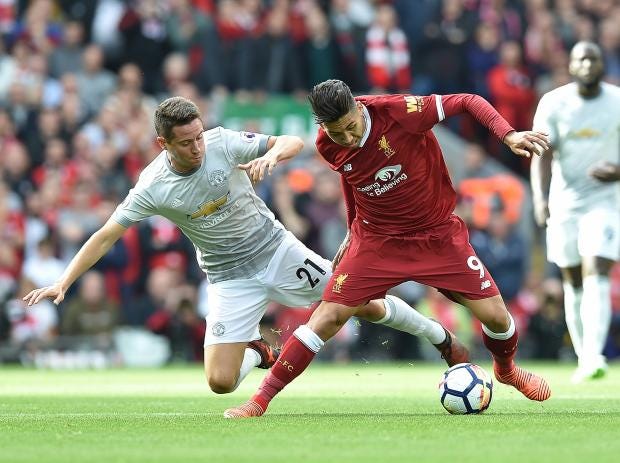
Liverpool 0-0 Manchester United: Tactical Analysis


A familiar fault reared its head as Liverpool once again failed to capitalise on their opportunities and consequently squandered the chance to win. Nonetheless, there was plenty to be pleased with in the performance: Mourinho’s typically deep line was unable to prevent the creation of a couple of big opportunities, and United’s erstwhile prolific attack never really looked like troubling the hosts’ back line. These plus points are both endemic of a change of tactical approach that has the potential to make Liverpool unstoppable.

The new tactic is in many ways a subtle change, but it could serve to dramatically improve results. Out of possession, things are much the same: Klopp has his players pressing high, looking to hustle the opposition into a mistake. This was very effective against United, who were forced to simply put the ball out of play on multiple occasions. The change has come in the approach when Liverpool do have the ball. Previously, attacks have been as frenetic as the turnovers in possession through which they were instigated; in other words, the plan was to nick the ball and then descend upon the goal as quickly and directly as possible. This worked to destructive effect against teams who left gaps to be exploited at the point of turnover, but opponents were increasingly opting to sit very deep against Liverpool so as to negate this risk. In response to this, Klopp has got his team playing much more patiently in the build-up phase. The only way to consistently break low blocks is intricate passing sequences – recently, these have become a much more regular feature. The idea is that teams can no longer feel safe sitting back: if they do so, the likes of Coutinho and Firmino will find a way through with their playmaking talents. This is good in and of itself, but what gives it the potential to be so effective is the fact that the attack still possesses the capability to launch explosive counter-attacks. Teams will be in trouble when they step up and in trouble when they sit deep – once the players are fully adjusted to the new method, there will be no simple way of stopping them.

In some ways, it is strange that this tweak to the system hasn’t come sooner: patient passing when in possession and aggressive pressing off-the-ball are a natural mix. When the opponent is only rarely afforded the ball, their natural tendency is to take more risks when they get it – they wish to capitalise on the fact they are actually in possession by turning that possession into a scoring chance. This risk-taking leaves them more vulnerable to the press: this allows a gap to be exploited at the turnover if it exists, and if it does not then the side playing the possession-based game nonetheless have the ball back. Thus the system serves as a potential way of creating chances, but also as a way of limiting chances for the opponent: given Liverpool’s defensive woes of late, any help they can derive from their tactical setup is welcome. To put it simply, the opposition cannot score if they don’t have the ball – the principle is basic, but the ramifications are significant. All the while Liverpool are moving the ball around, looking for an opening, they are simultaneously relieving the defence of all pressure; they may be called upon as ball-players, but this is one aspect of the game in which Matip and Lovren are fairly accomplished. As such, the new system being employed is working towards improving things at both ends of the pitch.

Why, then, did Liverpool still fail to pick up a win against United? There are two principle reasons. The first is that the adaptation to the new style is a work in progress: the team cannot be expected to transform into Guardiola’s Barcelona overnight, and the incision and fluidity of the passing therefore still left something to be desired at times. After a full season of being stumped by the deep line, it would be unrealistic to demand that the players immediately work out how to consistently unlock it. The second reason is that, even when the chances were cleverly carved out, they were not taken. Emre Can and Joel Matip missed the biggest opportunities of the match, with Mo Salah also failing to turn home from close range. This has been a big problem of late, and can also in part be attributed to Klopp’s tweak of the system. Under the old methods, nearly all of the chances created were 2v1s (or similar) by virtue of the way in which they came about: everyone charged forwards off the back of the press, overwhelming defences and creating easy scoring situations where the ball could just be passed home. Now, whilst some of the chances being made are still clear-cut, the goalkeeper cannot be taken out of the equation completely: faced with beating him, the players are struggling. Admittedly David De Gea is something of an exceptional case – he is one of the best keepers in the world, and his stop to deny Matip was extraordinary. Nonetheless, the problem applies more generally: Liverpool have to get better at burying their chances if they wish to reap the full rewards that the change in style has to offer.

All in all, though, the draw was more encouraging than it was frustrating. There are clear signs that Klopp’s amended tactical vision is starting to be understood and implemented, and when this comes to full fruition it will be fantastic.

-   - Follow me on Twitter @JamesMartin013

Tuesday, 7 March 2017

Liverpool 3-1 Arsenal: Why Are The Big Games Easier?

In a pleasing but head-scratching result, Liverpool once again triumphed over a top four rival with a convincing 3-1 win over Arsenal. It was the latest in a trend that is now far too prevalent to ignore: Klopp’s men can beat the big sides with relative ease, but struggle horribly against weaker opposition. The win came less than a week after a woeful showing against Leicester, and the results against Burnley, Swansea and other such teams remain fresh in the memory. Many have accused the side of lacking the right mentality – this does not seem right. A mentality issue may explain a few more off-days than one might like against smaller teams, but it doesn’t satisfactorily account for a systematic failure to break down teams from the bottom half of the table. Something else is definitely at play here; it is a tactical issue, and it needs to be resolved rapidly for Liverpool to reach their goal of top four this season.
The issue is Liverpool’s inability to break down the low block. The weakness was not regularly exposed during the first half of the season – it had not yet become apparent that the team struggled so much against deep lines, so opposition such as Watford came (laudably) to play an attacking game and got comprehensively overturned. This period of grace inevitably came to an end, however: opposing managers started to realise that sitting deep and springing counter attacks often yielded results against Liverpool. Of course, the vulnerability to counter-attacks would be partially alleviated by improving the defence: this is a personnel issue, however, and it gains little to point out such flaws when Klopp must work with what he has until the summer. What can possibly be dealt with is the consistent failure to create good chances against sides that sit deep. First, it is worth discussing why the low block causes Liverpool more problems than other big teams. Essentially, it flies directly in the face of the kind of football Klopp likes to get his side playing – it couldn’t exactly be characterised as counter-attacking, but certainly the element of suddenly breaking with pace to get in behind the line is a prevalent feature. The combination of runners from deep such as Lallana and Wijnaldum, the pace of Mane in a fluid front three and the accuracy of Coutinho and others in picking out the runs creates a team perfectly suited for exploiting gaps. Against the bigger teams, this works well. The excellent Leroy (@LFCImpulse) has made a video from the Arsenal game demonstrating how excellent off-the-ball movement leads to creation of space, which is then lethally exploited. This can be seen here: https://twitter.com/LFCImpulse/status/838728516539572224.
However, against sides determined to sit deep, all of this off-the-ball movement takes place in front of a solid bank of defenders. Thus nobody gets drawn out of their defensive position, and any space that is created is in an area which does not carry much danger for the opposition. At this point, Liverpool generally draw a blank. Occasionally Coutinho will bail the side out with a trademark long-distance strike, but these can hardly be relied upon as a consistent solution. What generally happens is a recycling of the ball out wide, where James Milner or Nathaniel Clyne will receive it. They are left in space deliberately, as they are unable to create chances with any regularity. Milner is playing on the wrong side, so tends to have to cut back inside; by the time he has done this, someone has generally been able to get out to him. Clyne lacks composure in the final third, and in general contributes little to nothing going forward. In any case, a wide threat will generally only be potent when there is a target man to aim at – Liverpool have no such player, so shifting the ball out wide is not really a viable solution for breaking down the low block. Quite the opposite: almost everyone else, sometimes including the centre-backs, come through the middle in support but find that it does not make a perceptible different to the threat level posed. Instead, gaps are left: this allows opposition to pick their moments and catch Klopp’s men on the counter.
The solution is two-fold. Firstly, and straightforwardly, a more direct style must be adopted. This does not mean direct in the sense of long balls, but rather assertive runs with the ball that force the opposition to close down in numbers. Even if the take-on fails, the run creates some much-needed space for others: if the runner can offload the ball before getting tackled, there is a genuine prospect of getting in behind the deep line. This would just require a simple instruction from Klopp: stop looking out wide so often, take a risk and take on the defenders. It is not as though there is an absence of technically gifted players in the Liverpool attack. Secondly, and perhaps more radically, is a switch to three at the back: specifically, a 3-5-2. Mane and perhaps Moreno would function in the wider roles – while this would be questionable defensively against a bigger side, it makes no material difference against the low block. The only threat comes on the counter, and currently when this happens Clyne and Milner are high up the pitch anyway. As such, it makes sense to have more attack-minded, direct players in the wider roles. This would mean that recycling out wide would not be an almost automatic waste of possession – Mane in particular has a tendency to cut inside and run at the defence, creating the possibility of space for others.
Naturally, such changes come with plenty of risks and no guarantees. However, the current form against bottom-half sides is so woeful that it surely has to be worth trying. Even if Klopp is reluctant to make a change to the formation, the reduction in balls out wide in favour of more on-the-ball runs should increase the chances of getting in behind and creating clear-cut chances. The ability to seamlessly ease pass our main rivals is a more than solid building block to be starting from – if the tweaks can just be made to fix the form against the lesser outfits, Liverpool will be title contenders again in no time.