Showing posts with label leicester. Show all posts

Friday, 16 March 2018

Weekend Preview


It’s a limited Premier League schedule this weekend due to the FA Cup fixtures, but there are still plenty of games to get excited about both domestically and abroad. Leagues and knockout competitions alike are approaching the business end – the so-called ‘must-win’ matches are coming thick and fast.
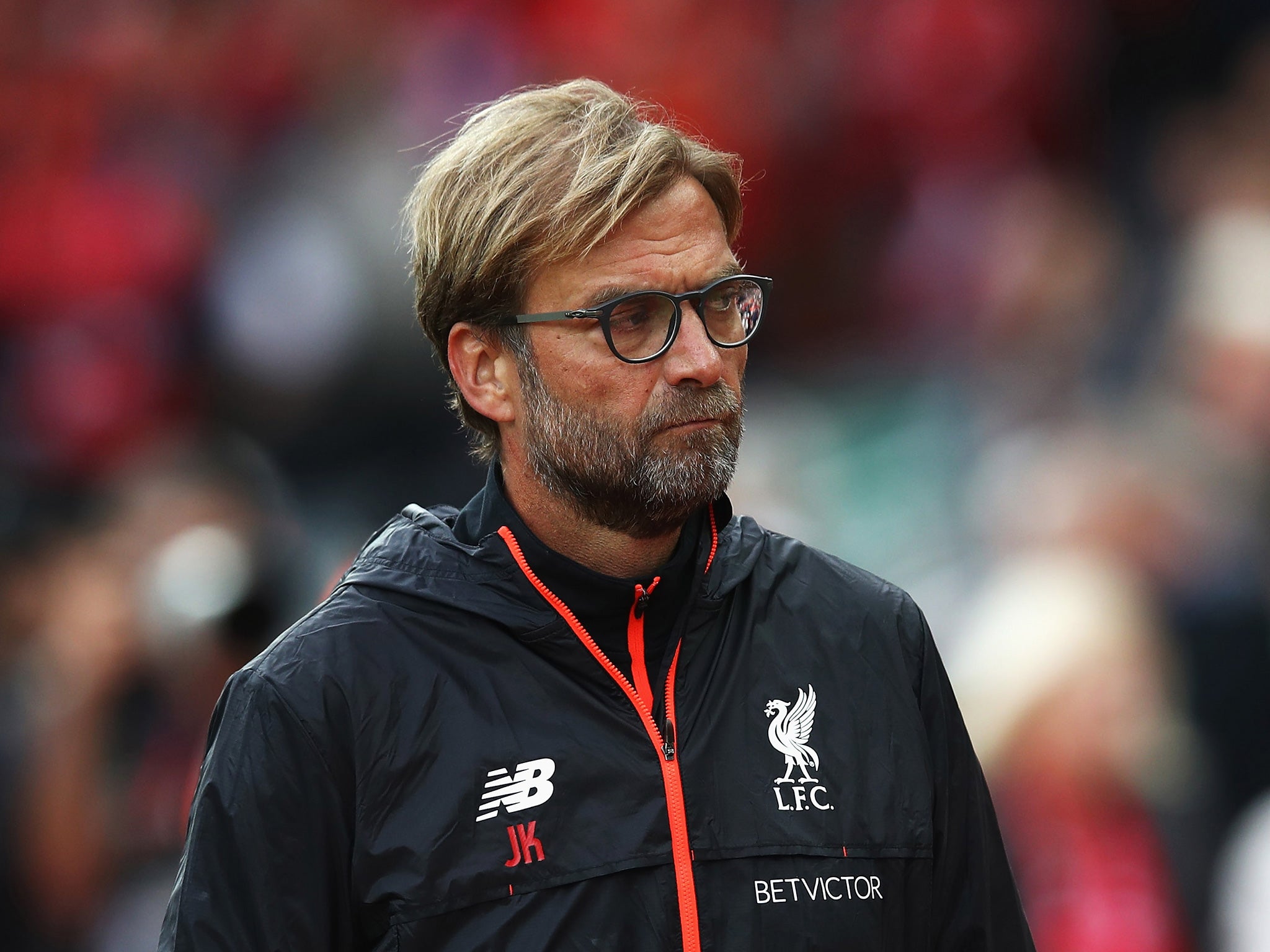

One of the league games that does go ahead in England is Liverpool vs Watford. This should be well worth a watch. Notwithstanding the disappointing defeat to bitter rivals Manchester United, the hosts are in scintillating goal-scoring form. Salah continues to go from strength to strength in his debut season on Merseyside, and Sadio Mane appears to be emerging from his mini-slump just in time to help the team’s efforts to secure a place in the top four. Javi Gracia has steadied the ship at Watford since taking charge, but defensive frailties are still clear for all to see: Arsenal were able to expose these last weekend, putting three past the Hornets defence. It would not be a surprise if Liverpool were able to match or better this tally. However, the visitors are also capable of finding the net – Klopp’s men found this out in the 3-3 draw on the opening day. A repeat of such a scoreline is clearly unlikely, but a high-scoring fixture seems all but guaranteed.


The FA Cup also offers some interesting match-ups. The pick of these is probably Chelsea vs Leicester. The home side are looking to bounce back following the disappointment of being knocked out of the Champions League; Leicester are no Barcelona, but they might well fancy their chances of capitalising on the vulnerability of their opponents. Conte’s men actually played quite well against the Catalan side, but were undone by multiple moments of sloppiness at the back – few forwards are better-equipped to pounce on errors than Jamie Vardy. However, barring a rout against a woeful West Brom side last weekend, Leicester have not been in great form. Chelsea will undoubtedly feel they can at least manage to score against The Foxes; a performance anything like the one that they produced midweek would probably be enough to see them through to the semi-finals, potentially giving Conte a slight hope of redemption. Given Chelsea’s exit from all other competitions and unsatisfactory league position, a loss might prove to be the final nail in the coffin.


Further afield, Real Madrid vs Girona could prove to be a fascinating fixture. At the start of the season, such a statement would have sounded absurd – a walkover would have been considered essentially a given. This is still a possibility, of course: it was not long ago that the newly-promoted side were comprehensively dismantled by six goals to one against Barcelona. However, since then they have produced three straight impressive wins. Celta Vigo, Villareal and Deportivo have all been brushed aside, leaving Pablo Machín’s side in seventh place. Their opponents are only four places higher, in third; there is a danger of dropping down to fourth if Zidane cannot orchestrate a win in this match. This would leave a campaign that is already highly disappointing for Los Blancos on the brink of becoming disastrous. Girona, meanwhile, could move as high as fifth. To occupy a Europa League spot at such a late stage would be a huge accomplishment for the team playing their first ever season in the Spanish top flight. Real probably have enough to see off their challenge, but it is unlikely to be straightforward.


The final pick comes from Serie A, where Inter Milan travel to Sampdoria. The two teams are embroiled in fights for Champions League and Europa League qualification respectively, making this a massive game for both clubs. Inter are looking to capitalise on their game in hand over Lazio to move into fourth place – to do so, they must win. A victory for Sampdoria, on the other hand, would propel them above Inter’s city rivals into sixth place, just five points behind Inter themselves. The Milan side managed an impressive draw with high-flying Napoli last time out, putting a serious dent in Sarri’s title hopes, and will be confident of continuing that good form in this game. Sampdoria, by contrast, are looking to bounce back from a surprise drubbing at the hands of relegation-threatened Crotone, to whom they lost 4-1. Another loss here may well effectively end a campaign that had shown such promise. This may consequently be something of a cagey affair, and ultimately it seems likely that Inter will come out on top.

Thursday, 18 January 2018

A Step Too VAR? How Video Technology Can Perpetuate Further Injustice


It was an historic moment. Leicester’s Kelechi Iheanacho had the ball in the back of the net, and wheeled away in celebration only to find the flag raised. On any other day, this would have dashed his hopes of doubling The Foxes’ lead and putting the FA Cup third-round replay against Fleetwood to bed. Not on this occasion: this was a fixture in which the ‘video assistant referee’ was being trialled, and Mike Jones duly informed on-field official Jon Moss that the goal should stand. Cue celebrations from Iheanacho, but also from most of the wider footballing community.


Were these celebrations premature? Certainly Iheanacho’s were not – he and his teammates were left standing around while Mike Jones pondered the tight call, and it was not until after the referee gave the signal that muted hugs and high-fives ensued. What of the jubilation further afield, where this intervention of VAR was lauded as the ushering-in of a shining new era for football? Unfortunately, those piling on the superlatives do not appear to have fully considered the consequences of the system. Some standard criticisms are well-rehearsed: amongst these is scepticism as to how well games will flow when they are prone to be interrupted by referrals, and it has to be said that the working of the technology in this instance did nothing to alleviate those concerns. However, it is a less talked-about consequence of the technology that provides the real sticking point.


Here is the issue. Imagine, for a moment, that Kelechi Iheanacho did not take on the early shot after running off the back of his marker, but instead opted to control the ball and work an even better shooting position by looking to go around the goalkeeper. By this time, the referee would have responded to his assistant’s flag and brought back proceedings – at this point, VAR is of no assistance. Unless the ball has actually been put in the back of the net only to be (initially) ruled out for offside, an assessment of the linesman’s call is out of the question: to take the scenario where Iheanacho looks to round the keeper, the referee can hardly order all of the players to return to the exact positions they were in at the point play was stopped in order to see how the passage would pan out. Not knowing for sure that a goal would have been scored, even though the finish would surely have been a formality, the officials cannot award the goal even once the incorrectness of the offside call has been established. Taking the keeper out of the equation is just as valid as the deft chip the Nigerian actually opted for, and would almost certainly have resulted in the same outcome, but this is disregarded under VAR – one gets the benefit of the technology, and the other does not.


There are two potential responses to this problem: one looks to dismiss it, the other to solve it. The solution that might be proposed is a modification of the situations in which the referee blows his whistle. Indeed, Graham Poll alluded to this as a consideration when giving his opinions in the immediate aftermath of the goal being awarded – the suggestion was that in his position as a referee in a match including VAR, John Moss should have made sure he delayed his blowing of the whistle until after it had become clear whether or not Iheanacho would score. In this way, the game would never be stopped prematurely on the basis of an incorrect decision from an assistant referee, and where the decision did turn out to be correct the ‘goal’ could be chalked off without much difficulty. However, neat as this sounds, it does not solve the problem. Bearing in mind that the vast majority of offside decisions are correct, how long does the referee let an attack run for before he acknowledges the flag? What even constitutes an ‘attack’ which he should let run in the first place? In 2013/14, Liverpool travelled to The Etihad to take on Manchester City. They took an early lead, and looked to have carved out a great opportunity to double it when Raheem Sterling was put clean through on the counter. Such was the high line of the hosts, this occurred on the halfway line: the offside flag was erroneously raised. There is no obvious answer as to what a referee assisted by VAR should have done in this scenario; on one hand Sterling was clean through and the play should have been allowed to unfold, with the offside call left for assessment afterwards, but on the other hand receipt of the ball on the halfway line could hardly be said to constitute an attack. Had Sterling been offside, as the linesman believed, allowing the move to continue would have meant allowing an entirely pointless break half the length of the pitch. There are no workable criteria on which to judge when and for how long the referee delays acknowledgment of an assistant’s flag, and this solution duly fails.

With no solution, proponents of the technology have to look to simply dismiss the issue that is posed by the possible variation in circumstances surrounding offside calls. The principal line of argument is that, while some would-be goals will inevitably still be disallowed, VAR nonetheless reduces injustice by correcting the situations where a goal immediately follows a stray offside flag and consequently lowering the total number of wrongly disallowed goals. It would be churlish to suggest that this argument is completely without merit. Certainly, it is at least arguable that a scenario where some wrong offside calls are corrected is preferable to one where none of them can be changed. However, this is not as inevitable a conclusion as it sounds. The current situation, though it produces immense frustration on a fairly regular basis, can at least say that it makes all teams and all match events equally susceptible to suffering unfairness by way of refereeing error. This equality is, perversely, a form of fairness: it acknowledges human error as an inescapable part of the game, and ensures that these errors are not channelled into a few specific areas. Video technology, meanwhile, produces a further category of unfairness by only functioning to correct errors of a particular type. It has been shown that this flaw is inherent – were there an effective way for VAR to eradicate all refereeing mistakes, there would of course be no controversy. Given this, it has to be asked whether it is a welcome addition to the game. A match where one valid goal is mistakenly flagged for offside and another stands is a cause of great consternation to fans; a situation whereby one mistaken call was corrected and another was left to stand would surely provoke even more outrage.


This is not a fatal blow to the case for video technology. There are undoubted benefits of VAR, and if it was to be brought in on a more permanent basis then fans and players alike would no doubt adapt to it before long. However, the problem of offside goals at least gives cause for consideration: there is a danger of getting swept away on the wave of hype generated by Iheanacho’s goal, when really it showcased the flaws with video assistants as much as the advantages. 

Monday, 12 September 2016

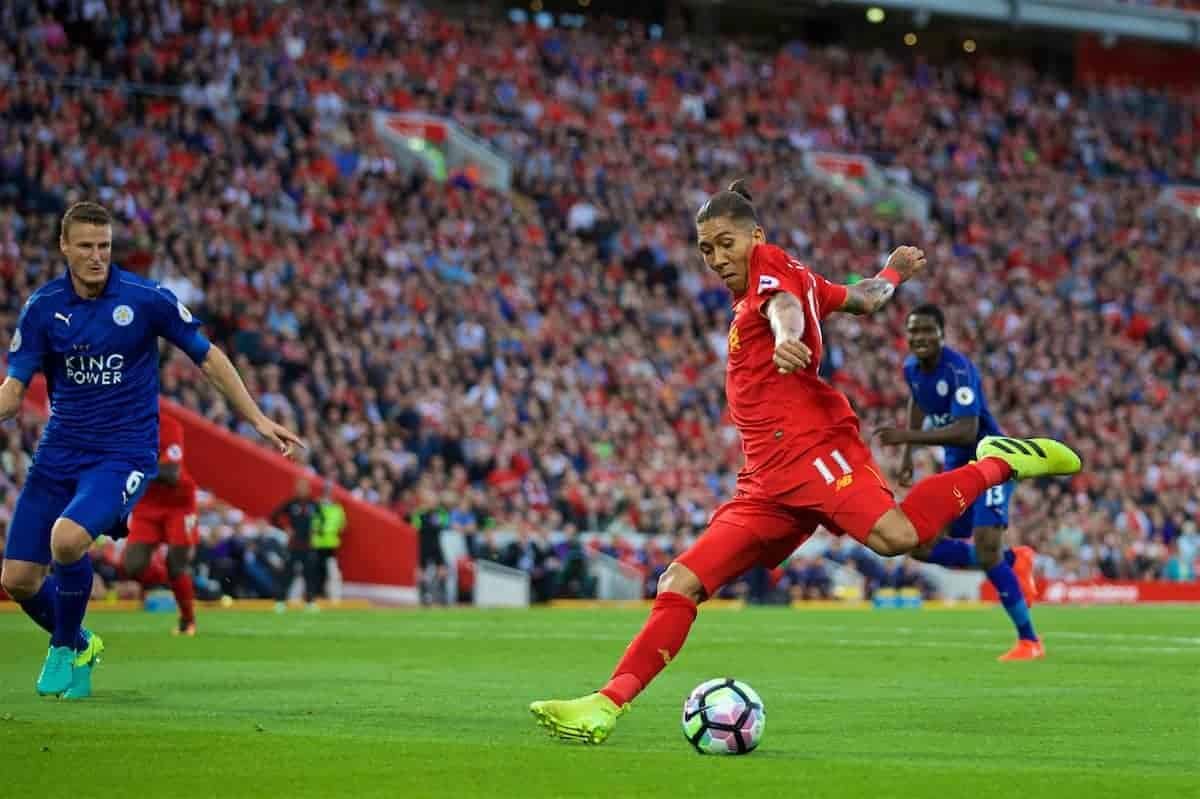
Liverpool 4-1 Leicester: This Is Anfield

In front of their biggest crowd since the days of standing in the terraces, Liverpool marked their return to the expanded-capacity Anfield with an emphatic win over champions Leicester City. The attack looked deadly and, one freak moment aside, the defence looked very strong – there were certainly signs that the extra fans in the Main Stand could be enjoying many more convincing victories this season.

The front three was altered from the trip to White Hart Lane; Coutinho missed out, having just returned from the Brazilian national team, and Sturridge came in to play in between Firmino and Mane. There were fears that the oft-influential playmaker would be missed, but these were allayed rapidly – roared on by the home crowd the hosts started quickly, and never really let up. Sturridge looked eager to make his case for regular inclusion in the first team, and had a big hand in the opening goal. His intelligent run drew two defenders wide, leaving Firmino free to drift through the middle and unerringly find the corner. This highlighted the fluid movement that has become ingrained in the Liverpool attack – the ‘centre-forward’ drifting wide left the centre-halves with a dilemma, and Firmino capitalised by coming central himself. Mane, too, had a good game: it was he who doubled the lead, finishing off a sumptuous move with a delightful chip over Kasper Schmeichel. Again, Sturridge played a significant role – after latching on to a nice pass he cleverly back-heeled the ball into the path of Mane. The Senegalese winger has enjoyed an electric start to his Liverpool career, delivering with consistency the quality that he could only show flashes of at Southampton. It is no coincidence that the one game where he was absent was Liverpool’s only defeat of the season so far: his direct, skilful runs would have asked questions of the Burnley defence.

At 2-0 up and approaching half-time, Liverpool looked in complete control. They were outplaying Leicester going forward, and Matip in particular was putting in an accomplished, assured performance at the back. Whilst his career at Anfield is still very much in its fledgling days, he looks as though he has the potential to be the commanding central defender that has been missing for so long. However, the solid defensive work was undone by a freakish incident involving make-shift defender Lucas. He received a pass from goalkeeper Simon Mignolet, initially controlled it well, but then took a bizarre, ballooning second touch. With Okazaki (who had incidentally run into the penalty area prior to the goal kick, technically an infringement) oncoming, he then stabbed the ball desperately back in the general direction of Mignolet. Unfortunately it raced past him into the path of Vardy, who was gifted the simplest of finishes into an empty net. Liverpool thus went into the break with only a slender one goal lead.

This, however, apparently did not prey on the minds of the players heading into the second period. Far from it, they looked determined to put the game to bed – Lallana did just that ten minutes into the half, rifling home a ferocious strike from the edge of the box after a nice lay-off from Wijnaldum. Having also struck for England during the international break, he is certainly doing a good job of dispelling fears about his finishing abilities. The tempo subsequently dropped off a little, although Liverpool still looked by far the more threatening team: Sturridge will have been disappointed he didn’t manage to notch a goal or two, having got into a couple of excellent positions. At the other end the assured defensive display continued, although in truth Leicester put it under minimal strain. Just as it looked set to end 3-1, Firmino and Mane combined to cap an excellent performance from the hosts. Mane ran through on to a long ball, getting there ahead of Schmeichel – he then had the presence of mind to find the better-positioned Firmino, who coolly sold his marker a dummy before slotting home. They were probably the two best players on the pitch, and the goal was no more than they deserved.


It was an excellent way to mark the opening of the expanded Main Stand – the bumper crowd had plenty to cheer as Liverpool extended an impressive home record against the previous year’s champions. The performance of the players on the pitch coupled with Klopp on the touchline and the new stand made it hard not to look optimistically on the future: there was an abstract sense of progress. Everything appears to be moving in the right direction – a return to former glories in the long term seems on the cards. That is not to say that in the short term Klopp and his men will settle for mediocrity: if Liverpool can keep on putting in excellent team performances such as the one witnessed against Leicester, there is no reason why we can’t be in the picture for the title race this season. At the very least Klopp will be hoping to challenge for a Champions League spot. Friday night sees Liverpool travel to Chelsea in what it sure to be a thorough test of the team’s credentials: based on the evidence of this game, there is no reason why they can’t come away with all three points.
-James Martin
Follow me on Twitter @JamesMartin013

Friday, 2 January 2015

Liverpool 2- 2 Leicester: Post-Match Thoughts

Sorry guys, false alarm! After our scintillating performance against Swansea last time out, I made the grievous error of writing that “we’re back”. In the first game of 2015 Liverpool presented us with fairly strong evidence that they are not in fact back in the form of a hugely disappointing 2-2 draw with bottom of the table Leicester. The dropped points leave us a sizeable seven points off 4th place, and casts huge doubts over our ability to finish in the top 4 this season.

In the understandable flood of emotion following the announcement that Steven Gerrard is to leave the club at the end of the season, nearly everyone seems to have forgotten that he has been extremely poor for (at a generous estimate) the last six months. Of course we should admire what he was in his prime and applaud his great service to our club, but what we should not do is persist in playing him out of sentimentality. His ‘legend’ status is the only thing getting him on the team sheet this season, and I would go as far as to say that it cost us the match yesterday. For the first time this campaign we fielded what I see to be our strongest back three: Sakho, Toure and Can. They all had reasonable games – Sakho in particular was superb – and would surely have been capable of holding on to a two goal lead had they received even a small level of cover from the defensive midfielders. As it was, Gerrard’s total lack of mobility meant that the back three were constantly exposed; essentially, he was a wasted player in the line-up. Had Rodgers opted for the same team that won at Swansea, we’d probably have won.

It wasn’t just the line-up that Rodgers got wrong. His in-game switches were bizarre; Borini came on for the injured Lallana just after half time, when Markovic would surely have been both better suited to the position and more capable of making an impact. At 2-2 he made another odd change. We needed a goal, so he decided to take off Moreno for Lambert. This was nonsensical for multiple reasons. Firstly, and most simply, Lambert is painfully ineffectual and has not once made a notable impact as a substitute. Secondly, the whole point of buying Lambert was a ‘Plan B’ that allowed us to whip crosses into the box – Moreno is our quickest wide player, and would have been the ideal candidate for getting down the flank and putting crosses in towards Lambert. These decisions alone cannot take all off the blame for the failure to get a win, but they certainly played a part.

A very strong case can be made that Liverpool deserved absolutely nothing from the game. Both of their goals were penalties, the first of which was definitely given incorrectly. Jeffrey Schlupp slid in to block Sterling’s cross and the ball struck his face – the referee deemed it to have struck his arm and pointed to the spot. Admittedly Schlupp shouldn’t have gone to ground with his arms spread out, but it wasn’t a handball. The second penalty definitely hit a hand – Simpson’s to be precise – but he had very little time to react and move his hand out of the way. It is clear, therefore, that Liverpool can count themselves lucky to come out of a home fixture against 20th place Leicester with a point; this is indeed a sorry state of affairs.

To conclude, if Brendan Rodgers wants even a distant chance of guiding Liverpool into the top 4, he has to make the brave call of dropping Gerrard in his final half season. We saw at Swansea what we can achieve without him in the team, and we saw yesterday how little he contributes when he is in the side. The article that celebrates the achievements and service of the legend that is Steven Gerrard will surely be on its way, but this is not the time for sentimentality. This is the time for cold, hard realism, and if Rodgers doesn’t show that same level of realism then we can wave goodbye to our hopes of Champions League football next season.
-James Martin
Follow me on Twitter @JamesMartin013


Wednesday, 3 December 2014

Leicester 1-3 Liverpool: Post-Match Analysis


Yesterday, Liverpool secured their second consecutive victory in a 3-1 win over Leicester. Although there were times when the defence showed the frailties that it has displayed throughout the season, the performance was, on the whole, a big improvement on what we’ve been seeing for much of the campaign. Having been rested for most of the game against Stoke, Gerrard was deployed further forward in this match – he chipped in with Liverpool’s first goal, and subsequent strikes by Adam Lallana and Jordan Henderson were enough to seal the three points for the reds.

Just like in the Stoke game, Raheem Sterling had a big influence against Leicester. He started the season exceptionally, but has looked jaded for much of the campaign. His sudden rise to stardom has led to multiple England call-ups, and the pressure of being “the future of English football” has naturally weighed heavily on his shoulders. However, it looks like he may well be back to his best; he spent 90 minutes giving Ritchie De Laet nightmares, and provided key contributions to two of the Liverpool goals. Sadly, his form was of no use to us in solving our defensive problems: these remained clear for all to see, and for Leicester to exploit. They did this through a high pressing system; it was only a matter of time before they managed to force an error. The error, when it came, was from Simon Mignolet – his pass was woefully misplaced and left Esteban Cambiasso an open goal to aim at. Somehow the Foxes passed up the opportunity, but the chance proved the trigger for a barrage of Leicester attacks that did eventually culminate in a goal. The goal itself was somewhat fortunate: Ulloa’s shot came back off the post, struck Mignolet’s back and went in. Perhaps this was some sort of karma for the Belgian’s earlier error, or perhaps it was simply good fortune for the hosts. Either way, the result was Liverpool trailing to the bottom club in the Premier League.

So far this season Liverpool fans have become accustomed to seeing their team curl up in a ball and whimper when they concede. This time it was different. This time we saw the Liverpool who took their title challenge to the last day of the season in May. Whilst the quality of Suarez and Sturridge wasn’t there, the sheer determination and drive was there in abundance. Lallana equalised for Liverpool just four minutes after they went behind: after Lucas (who had another excellent game) had crossed the ball in, Lambert knocked it into the path of Lallana who fired home emphatically. The next goal came nine minutes into the second half. Somewhat fittingly, it was scored by a man who epitomises the aforementioned determination. After Raheem Sterling’s drilled cross could only be half-cleared, Steven Gerrard was on hand to smash the ball into the back of the net. Although the time has clearly come for him to accept a reduced role at the club, this strike proved that, when used sparingly in a more advanced position, he can still have a big impact.

Sadly, at this point, the red charge petered out a little. Wes Morgan was shown a straight red for wrestling Lambert to the ground, but if anything this seemed to weaken Liverpool’s attacking impetus. It was Leicester piling on all the pressure for much of the second half, and Mignolet was required to make some good saves to keep his side in front. Kolo Toure was also instrumental: his recent performances have rightly been enough to keep Dejan Lovren out of the side, and his showing at the King Power was no different. Skrtel also showed willing to put his body on the line; a cannonball of a shot hit him right on the head, causing the game to be delayed lengthily so he could receive treatment. It was encouraging to see a fairly competent defensive showing for once. The first half was shambolic at times, but the back line prevented Leicester’s pressure from amounting to anything during the second period.

The delay to treat Skrtel resulted in seven minutes being added on. This would surely have been a nervy ending for Liverpool had it not been for Jordan Henderson – he put the game to bed by scoring in the 83rd minute. Sterling was key in making the goal. After an optimistic long shot was parried by Schmeicel, Sterling was first on to the ball. He then backheeled it perfectly to the feet of Jordan Henderson, who was left to blast it into an unguarded goal. This intricate link-up play was something that happened fairly regularly during the match, and it is a sign that the team are starting to properly gel together. If we can continue to work well as a unit, there is no reason why we can’t win against Sunderland at the weekend. More important is the game on Tuesday – although our current form is drastically better than a few weeks ago, Basel will surely prove tough opposition. That said, the quality within our squad is definitely enough to overpower Basel, so if our form continues on this upward trajectory then we should be able to get the win and advance to the Champions League knockout stages.
-James Martin

Follow me on Twitter @JamesMartin013